
When the owner of a Pune distribution business opened his third branch, the whole office got sweets.
The business now had branches in Nashik, Nagpur and Indore. More branches meant more customers, more sales and more trucks on the road. It felt like the business had finally arrived.
Six months later, the owner spends every Monday morning on the phone. This week he called all three branches about the monthly stock count. Nashik had finished on Friday. Indore had counted only the fast-moving items, because that was how its manager had learned it. Nagpur, run by his cousin, said everything was fine and the numbers would come soon.
All three branches run the same process, and each one runs it differently.
Anyone who has tried to manage multiple business locations knows this feeling. Each new branch adds sales, and it also adds distance between the owner and the work.
| To manage multiple business locations, run every branch on the same written processes, give each step a clear owner, and see all branches’ work in one place. The owner then steps in only when something is late, instead of calling each branch to ask. |
Why Every New Branch Makes the Business Harder to Run
More of India’s work now happens outside the big cities. In a study of more than 480,000 workers across 640 locations, staffing firm Quess found that 69% worked in tier-2 and tier-3 cities (Quess Pulse Report, FY2026). For a growing business, that means more branches far from the owner, run by local teams he rarely sees.
Every branch runs on a few people. The storekeeper knows how the count is done, the admin officer knows when the licenses expire, and the branch manager knows who to call at head office. As long as those people stay, the branch works.
People move, though. In the same Quess study, 55% of workers had been in their current role for less than a year. When one of them leaves, the way work gets done at that branch can leave with them.
Distance makes this harder to catch. With one location, the owner would notice a gap within a day. With four, he finds out weeks later, usually through a problem. The Pune distributor’s branches show three versions of it:
- Indore counts stock the way one manager learned it, so the method lives with him.
- Each branch’s renewal dates sit in one person’s diary.
- A staff transfer depends on three people in three cities remembering to tell each other.
The answer is to move the work out of people’s heads and into a system the owner can see, one layer at a time.
How to Manage Multiple Business Locations, One Layer at a Time
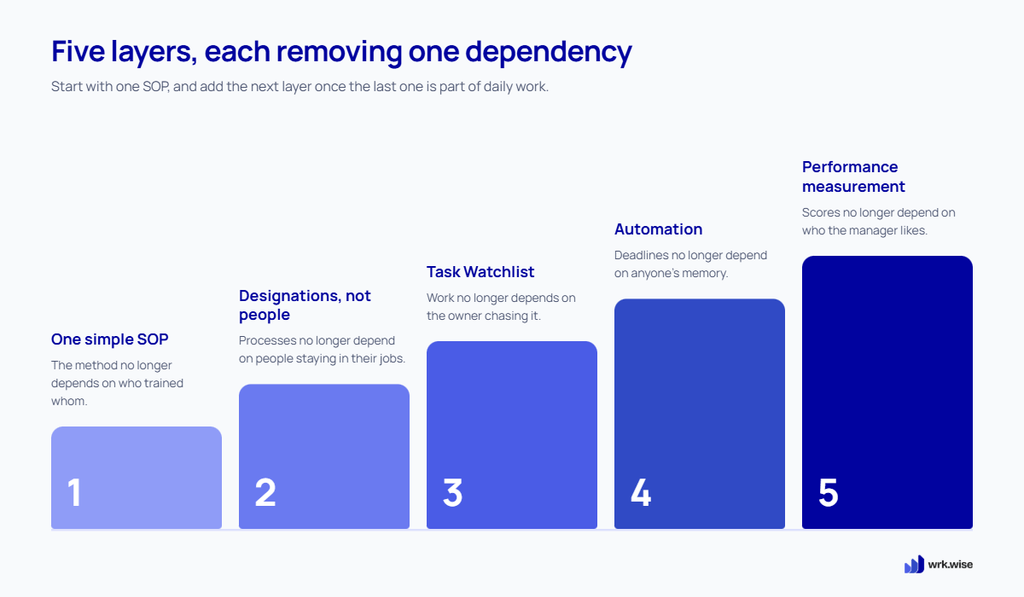
In wrk.wise, everything starts with the SOP. It creates the tasks, passes each one to the next person when it’s done, and records it against its deadline. Start with one or two simple SOPs, and add more as your team gets used to working this way.
As you build, the structure grows in five layers: tasks, SOPs, designations, automation and performance measurement, and each one removes another way the business depends on a single person. Here are the five layers, shown through the Pune distributor’s branches.
1. Start with one simple SOP
Indore counted only the fast-moving items, because that was how its manager had learned it. Nashik counted everything. Nobody at head office knew the two branches were doing the same job differently.
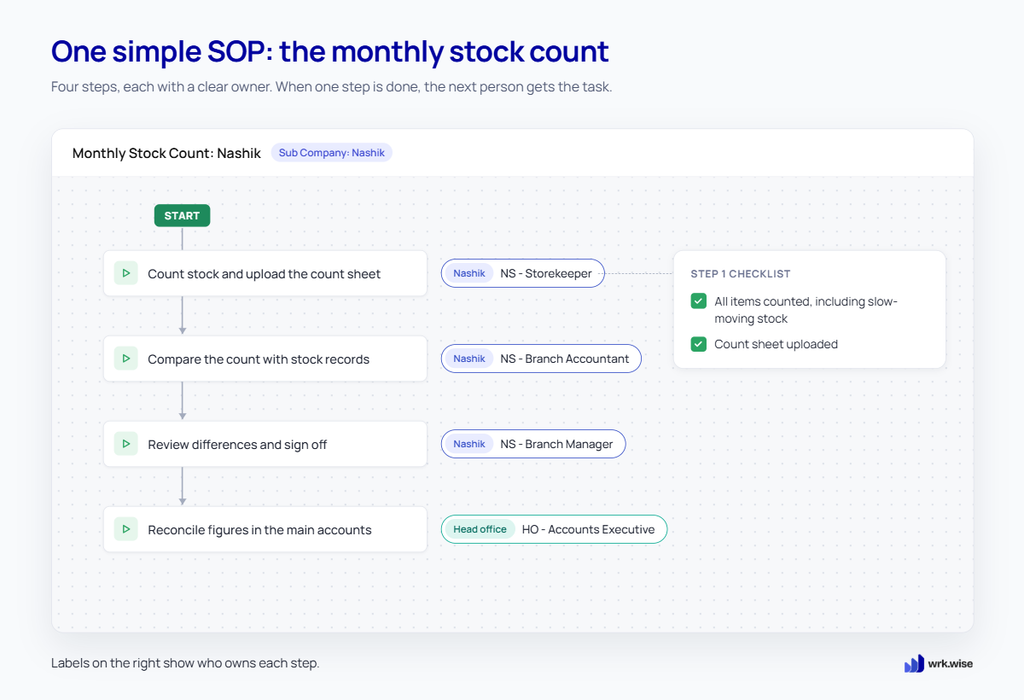
So the owner built the stock count once, as an SOP in wrk.wise, with four steps:
- The storekeeper counts every item and ticks “all items counted, including slow-moving stock.”
- The branch accountant compares the count with the records.
- The branch manager reviews any differences and signs off.
- The head office accounts team reconciles the final figures.
Every month, the SOP turns these four steps into tasks for the right people at each branch. Indore can’t skip the slow-moving stock anymore, because the checkbox sits inside the task itself. If you’re writing your first SOP, our guide on turning SOPs into daily work walks through it. With this layer, the method stops depending on who trained whom.
2. Assign steps to designations, not people
A few months later, the owner moved his best storekeeper from Nashik to Indore. The Nashik manager relieved him on Friday and assumed head office knew. Head office was waiting for paperwork. On Monday, Indore wasn’t expecting him, and his salary was still going through Nashik.
Two things in wrk.wise stop this from happening again:
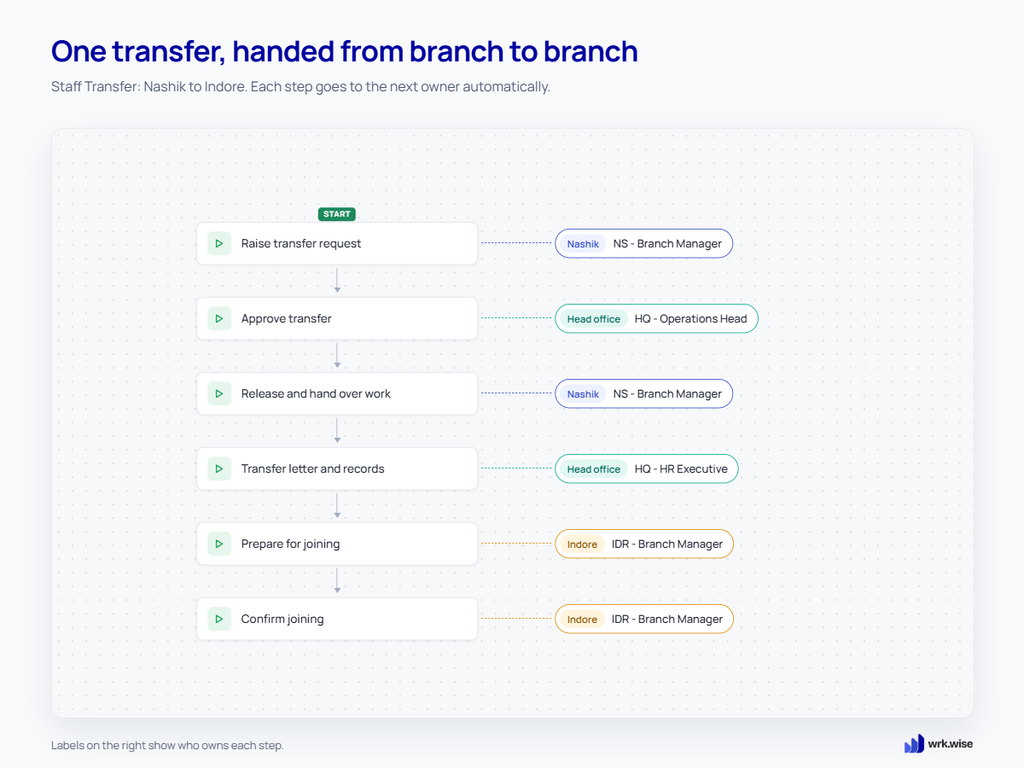
- Every step goes to a designation instead of a person. Nashik’s count goes to NS – Storekeeper (a designation named with Nashik’s branch code), so whoever holds that job gets the task, including a new hire on their first day.
- The transfer runs as one process across all three places. The Nashik branch manager (NS – Branch Manager) releases the employee, head office approves and issues the letter, and the Indore branch manager (IDR – Branch Manager) prepares for joining. Each person gets their task the moment the previous one finishes.
The gaps between teams are where handoffs usually break, even inside one office, as we explain in why every department needs workflow management. With this layer, processes stop depending on specific people staying in their jobs.
3. See every branch’s work in one place
The owner used to spend every Monday morning on the phone. Nagpur, run by his cousin, always said things were fine. Two weeks after one of those calls, a large order came in, and the stock Nagpur had reported wasn’t on the shelves.
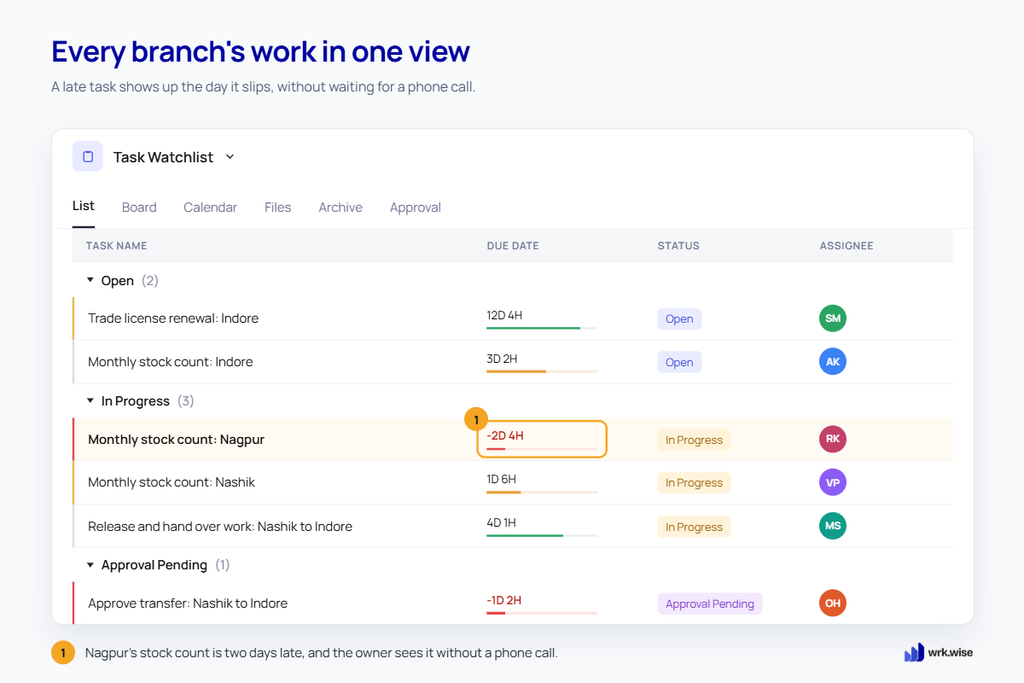
Now he opens the Task Watchlist instead. In one view, he sees:
- every branch’s open tasks and who owns each one
- what is due this week
- what is already late, such as Nagpur’s stock count, two days overdue
Drivers and sales reps see their own tasks on the wrk.wise mobile app, instead of digging through chat groups. That gap is common: 65% of frontline workers in India say messages from leadership never reach them (Microsoft Work Trend Index, 2022).
The owner stops being the person who holds everything together, which is the idea behind Business on Autopilot. With this layer, work stops depending on the owner remembering to chase it.
4. Automate handoffs, reminders and renewals
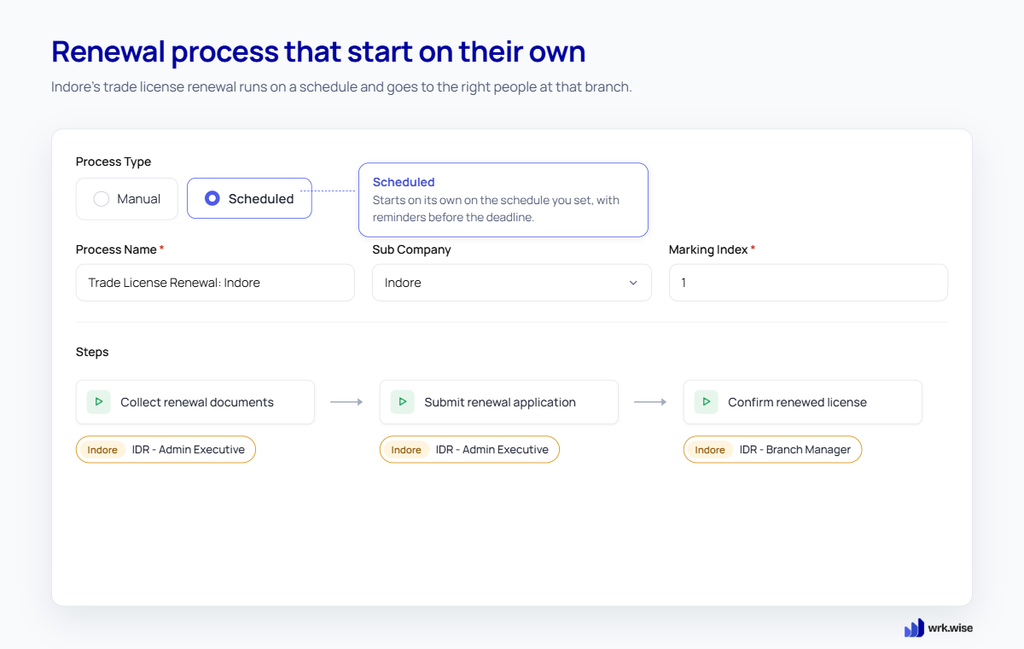
Indore’s trade license renewal date lived in one admin officer’s diary. When she left the company, the reminder left with her, and the branch only found out when the license was about to lapse.
That diary was carrying more than anyone realized. Indian businesses deal with 69,233 compliances under 1,536 laws (TeamLease RegTech and ORF), and with branches in Maharashtra and Madhya Pradesh, the distributor answers to two states’ rules at once. That is too much to leave in one person’s memory.
Because tasks come from SOPs, wrk.wise handles three kinds of follow-up on its own:
- When one step is finished, the next person gets their task automatically.
- Reminders go out before every deadline.
- Renewals run as scheduled SOPs, which start by themselves on the schedule you set and go to the right person at that branch.
The admin officer can leave, and the renewal still starts on time. With this layer, deadlines stop depending on anyone’s memory.
5. Measure performance from the work itself
At appraisal time, the owner faced a harder question: how good was each branch manager, really? Without records, the answer came down to who sounded confident on the phone, and one of those managers was his cousin.
wrk.wise builds the answer from work that is already recorded:
- Every task from an SOP is saved with who finished it and when.
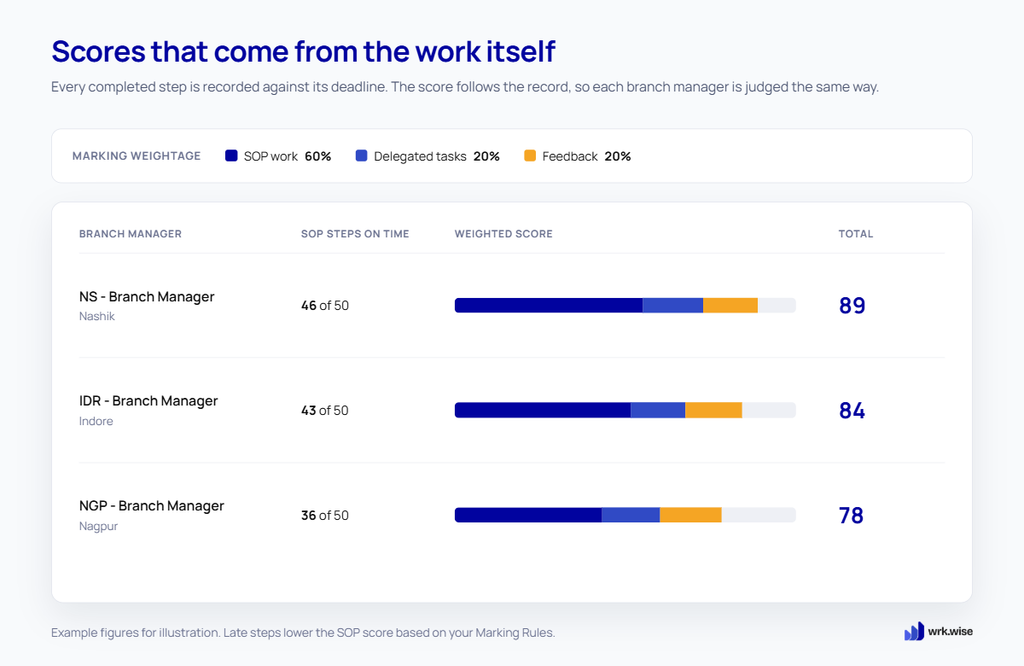
- Each finished step is scored against the deadline set in the SOP, so a count done on time scores higher than one done two days late.
- The company decides how the final score is split, for example 60% for SOP work, 20% for delegated tasks and 20% for feedback.
The owner still makes the final call, but now he can compare Nashik, Nagpur and Indore on the same rules. What happens when that record is missing is the subject of why fair-looking appraisals still feel unfair. With this layer, performance stops depending on who the manager likes.
Start Small: Add One Layer at a Time
The layers work best in order, and each one is useful on its own. A comfortable pace looks like this:
- Month 1: Build one simple SOP, such as the stock count, and run it at every branch.
- Month 2: Switch its steps from names to designations.
- Month 3: Follow every branch’s work on the Task Watchlist, and bring field staff onto the mobile app.
- Month 4 onward: Add reminders, branching steps and scheduled renewals, then start measuring performance.
Treat the months as a guide. Move to the next layer once the last one is part of daily work. No branch has to stop working while it changes, and there is no big launch day.
Run Every Branch the Same Way
What the Pune distributor needed was simple: work that keeps running when people change, an owner on every step, and results that reach him without a phone call.
When the way work gets done lives in one person’s head, every new branch adds risk. When it lives in a written process, every new branch can start from the same playbook. Expertise in one head is a risk. Expertise in a process is an asset.
See how wrk.wise works for businesses with several companies or branches.
FAQ
How do you manage multiple business locations?
Manage multiple business locations by running every branch on the same written processes, with a clear owner for each step. Then track all branches’ tasks and deadlines in one place, so you see delays without calling each branch.
What are the biggest challenges of managing multiple locations?
The biggest challenge is that each location runs on a few people the owner can’t see. Methods drift from branch to branch, news arrives late, work gets lost between branches, and deadlines live in someone’s memory. All of these grow with every new location.
How do you keep processes consistent across branches?
Keep processes consistent by writing each one down once, step by step, and assigning every step to a designation instead of a person. Every branch then follows the same steps, even when staff change.
How can an owner monitor branches without visiting them?
An owner can monitor branches remotely by tracking every branch’s tasks, owners and due dates in one shared system. Late work shows up the day it slips, so the owner steps in only when something needs attention.
What software helps manage multiple business locations?
Look for software that starts with simple tasks and grows into SOPs, steps assigned by designation, automation and appraisals, so structure can be added gradually. wrk.wise works this way, with group-wide or branch-level processes, a Task Watchlist across branches and a mobile app for field staff.