
AI tools are making tasks faster. But many businesses still face the same old problem: work is scattered, ownership is unclear, and no one is quite sure what happens next.
New technology has always arrived with big predictions. Around 1839, the French painter Paul Delaroche saw a photograph for the first time. He reportedly declared, “From today, painting is dead.”
Painting survived. Photography did not end art. It changed what art was for.
The AI conversation feels similar today. Every week brings a new prediction about jobs disappearing and industries changing overnight. Some of it may prove true. But new technology rarely removes the need for work. It changes how the work gets done.
Underneath all that change, one thing has not moved: businesses still run on processes.
How AI Is Changing Jobs and Tasks
AI is changing jobs by changing the tasks inside them. It automates some work, assists with other work, and leaves the rest to people.
Clean Tasks, Messy Tasks
Economist Luis Garicano, co-author of Messy Jobs with Jin Li and Yanhui Wu, argues that a job is not one task. It is a bundle of tasks. Some are clean: predictable, rule-based, and easy to hand to a machine. Others are messy. They involve judgment, relationships, and situations with no clean answer.
Picture a factory manager. Her Tuesday starts clean.

She opens her laptop, and an AI tool has already drafted the week’s production summary. It has pulled yesterday’s output numbers and flagged two invoices that don’t match the purchase order. She checks them and approves what looks right. The morning is done in twenty minutes instead of two hours.
By 2 p.m., the day turns messy. A key supplier calls to say a shipment will be late, and it will delay two client deliveries.
She has to decide which client to tell first. She has to weigh pulling stock from another line against straining a long-standing vendor relationship, all while trying to hit the deadline. No tool drafts that conversation for her. No dashboard tells her which client will forgive the delay and which one won’t.
Same job. Same person. One half of her day got faster. The other half still needed her.
Jobs Are Being Redefined, Not Deleted
ADP Research calls this shift “the great job unbundling,” and the numbers show it happening. PwC’s 2026 AI Jobs Barometer found that since 2018, headcount at the most AI-exposed companies grew 52 percent, compared with 36 percent at the least exposed.
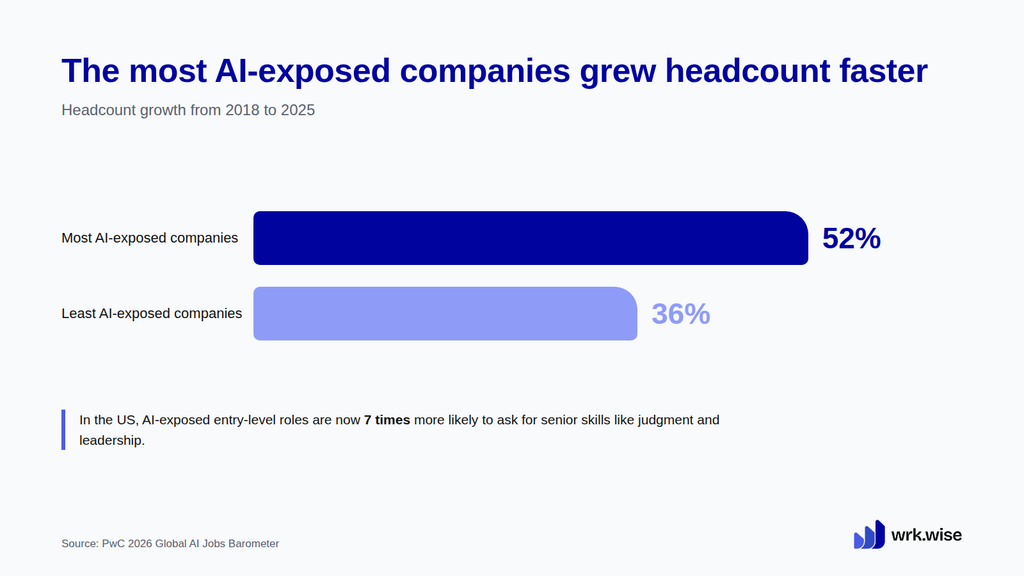
In the US, AI-exposed entry-level roles are now seven times more likely to ask for traditionally senior skills such as judgment and leadership. For a business owner, this cuts both ways.
AI can help a team move faster. It also quietly rewrites job descriptions, training needs, and what “doing the job well” means. What AI is not removing is the need for organized workflows and clear ownership. If anything, it is raising the cost of not having them.
What Still Does Not Change in Business Operations
Tools evolve. Job titles shift. But every business still depends on the same core functions: sales and marketing to drive growth, operations to deliver, finance to protect the company’s health, HR to build the team, and customer support to protect trust.
AI changes how the work inside each function gets done. Marketing uses it for content, finance for reporting, HR for screening, support for chatbots. Some AI tools can even route work and assign next steps.
But AI can move work. It cannot answer for it. Someone still has to decide what matters, set the rules the work follows, and own the outcome. AI multiplies productivity. It does not replace responsibility.
Why Every Business Function Runs on a Process
A function only works when there is a process behind it. Without one, a team can be busy all day and still not move the business forward.
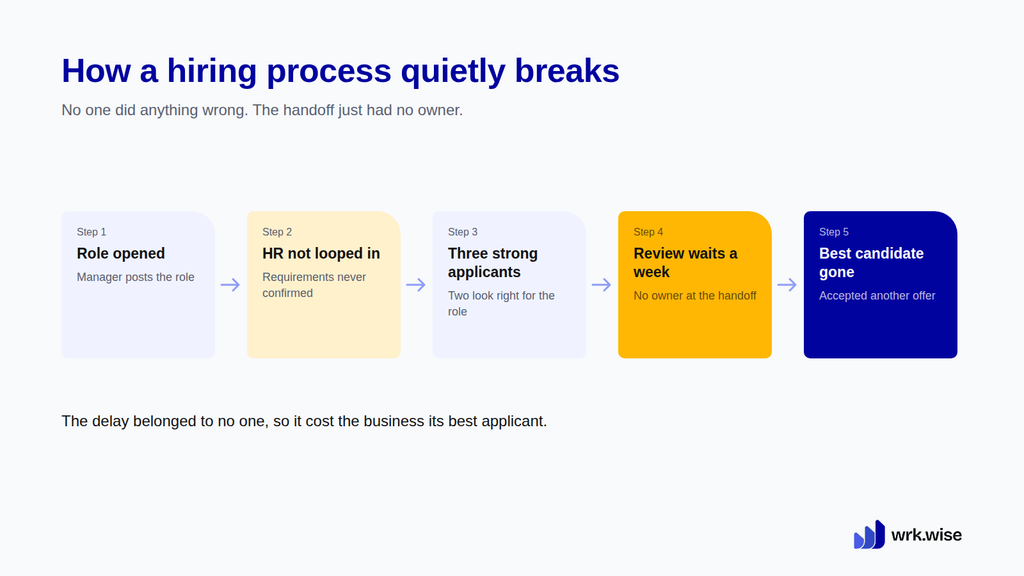
Take hiring. On paper, it looks simple: a role opens, someone applies, someone gets picked. In practice, it is one of the easiest processes to quietly break.
A manager opens a role and posts it, but forgets to loop in HR on the exact requirements. Candidates apply, and three look strong. One manager reviews them and likes two, but he is buried in his own work for a week before he replies.
By the time feedback comes back, the strongest candidate has already accepted another job. No single person did anything wrong. The process simply had no owner at the handoff point, so the delay belonged to no one and cost the business its best applicant.
The same pattern shows up everywhere:
- Sales: A qualified lead sits untouched over a weekend because no one owns the follow-up after the first call.
- Customer onboarding: A new client signs, but the handoff from sales to delivery never formally happens, so the client’s first thirty days drift.
- Project delivery: A task is finished, but the next person doesn’t know it’s ready, so the project stalls at a step with no real blocker.
Different function, same failure. Work exists. Ownership does not.
Why AI Without Clear Processes Creates Confusion
Growth that outruns control is not a new problem. Kotak Mahindra Bank, one of India’s largest private banks, learned this in 2024.
The bank relied heavily on digital channels to win new customers. But its IT systems and controls had not kept pace. Examinations in 2022 and 2023 found gaps in areas like change management, access control, vendor risk, and business continuity, and the bank did not fix them in time. The Reserve Bank of India stepped in and stopped Kotak from onboarding customers online or issuing new credit cards.
The restrictions lasted about ten months. They were lifted in February 2025, after the bank fixed its controls and an external audit confirmed the work.
Kotak’s problem was never a shortage of digital tools. Its growth had moved faster than the structure behind it. And what got the bank moving again was not a new tool. It was fixing that structure.
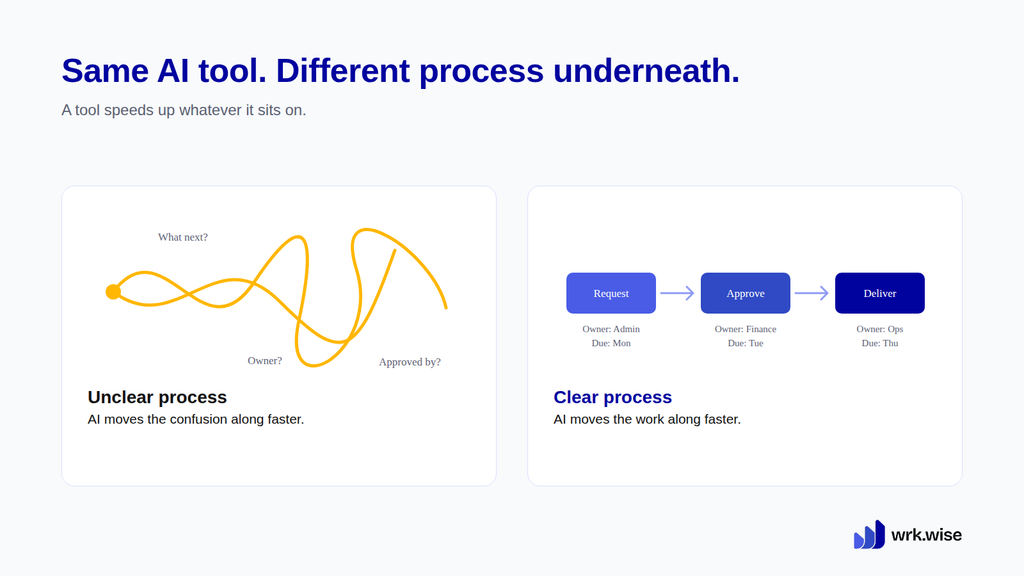
AI can create the same pattern inside any business. Put a powerful tool on top of an unclear workflow, and it won’t fix the confusion. It will move the confusion along faster.
Why Structured Execution Will Win
The winners of the AI era will not be the businesses running the most tools. They will be the ones that fit those tools inside a clear operating structure.
Tata Steel shows the opposite of Kotak’s story. Before scaling any digital tool, its sales and marketing teams aligned on specific business problems. They tested ideas in small pockets and scaled only what worked.
When Tata Steel built AASHIYANA, its digital platform for home builders, it started by mapping the customer’s actual journey, not by picking software. The platform supported a sales process that had already been redesigned around the customer.
You don’t need Tata Steel’s budget to use this lesson. Mapping a process on paper, step by step, with an owner for each step, costs nothing. That is the part that made Tata’s technology pay off, and it is the part most businesses skip.
A business with ten AI tools and no clear process will struggle to show results. A business with a strong process can put AI to work right away, because the structure to receive that speed already exists.
From Process Documentation to Process Execution
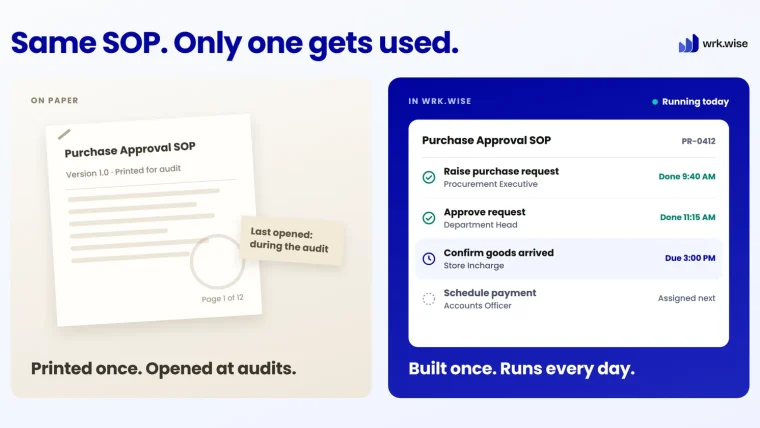
Many businesses are not failing because they lack a plan. They have SOP documents, workshops, and good intentions. The plan usually exists somewhere in a folder.
The gap opens when daily work begins. A task gets missed because no one clearly owned it. A deadline slips because the approver didn’t know it was waiting. The process that looked airtight in a slide deck depends, in practice, on someone’s memory and someone else’s follow-up call.
It is the clean-and-messy problem again. Writing the SOP is the clean part, and it gets done. Making people follow it every day is the messy part, and it doesn’t.
Closing the Implementation Gap
This is the gap wrk.wise is built to close.
You build each process once in wrk.wise as an SOP. Every step gets a role as its owner, not a person’s name, so the process keeps working when people change. When someone starts the process, wrk.wise creates the tasks, each with a deadline. When one step is done, the next task goes to the next owner automatically. No one has to remember to pass it on.
Go back to the hiring story. The manager’s review would have been a task with his role on it and a due date. If it slipped, his line manager would see the delay on the Watchlist and could step in while the best candidate was still available.
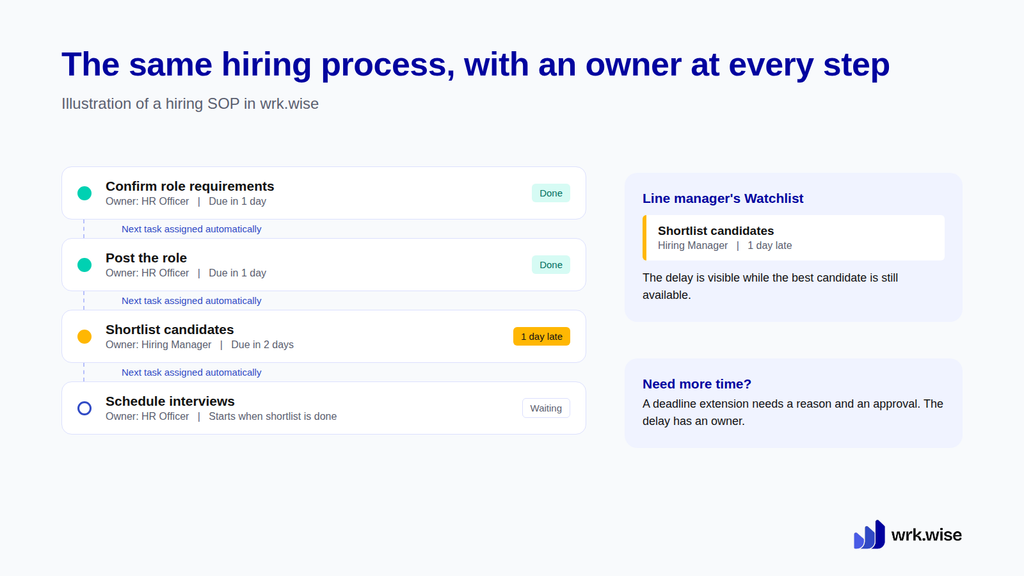
Deadlines can still move. But in wrk.wise, moving one requires a reason and an approval. The delay has an owner.
None of this replaces judgment. The factory manager still has to decide which client to call first. wrk.wise makes sure the clean half of the day doesn’t eat the rest through chasing, reminding, and re-explaining.
The Constant in an AI-Driven World
Delaroche was wrong about painting. He was right that new technology shifts the ground under a craft. It just rarely removes the need for the craft itself.
AI will keep reshaping jobs and teams. But a business still needs a clear process to produce a repeatable outcome, clear ownership to move work forward, and accountability to turn a plan into a result.
The businesses that come out ahead won’t be the ones that adopted the newest tool first. They will be the ones that built a structure strong enough to hold it.
AI tools can change how fast work gets done. Organized workflows still decide whether that work actually moves.
FAQs
1. Will AI replace jobs completely?
AI is likely to replace some tasks, especially routine ones. Most jobs also involve judgment, context, and relationships, and those parts still need a person.
2. How is AI changing jobs?
It automates the routine parts of a role and raises the value of the parts that need judgment, communication, and ownership.
3. Why do processes still matter in the AI era?
A fast task is not a finished process. Even work that AI completes in seconds still needs an owner, an approval step, and a next action.
4. Can AI fix a broken business process?
Not on its own. If ownership and approvals were never defined, AI makes individual tasks faster while the overall process stays confusing. Make the process clear first, then add the tool.
5. What does structured execution mean?
It means turning work into workflows with a clear owner, a deadline, and visible progress, so the team always knows what comes next and who is responsible.
6. How does wrk.wise help?
It turns each process into a workflow with a role-based owner, a deadline, and an automatic handoff at every step, so execution doesn’t depend on memory or follow-up calls.