
Your appraisal system can be completely fair and still make good people quit. It sounds like a contradiction. It isn’t.
TL;DR
- A completely fair appraisal process can still produce an unfair result, because managers score from memory, comparison, and whoever complained loudest, not a full record of what happened.
- Four everyday biases cause this: recency bias, contrast bias, the idiosyncratic rater effect, and visibility bias.
- More metrics don’t fix it. A number without context, like task count, still can’t tell a hard job from an easy one.
- If you’re the one running appraisals: wrk.wise records who did what, how much each task counted, and how strictly lateness gets judged, before a manager ever fills out a review.
- It doesn’t replace judgment. It bounds how much of the final score depends on it.
Fair Rules, Unfair Outcome
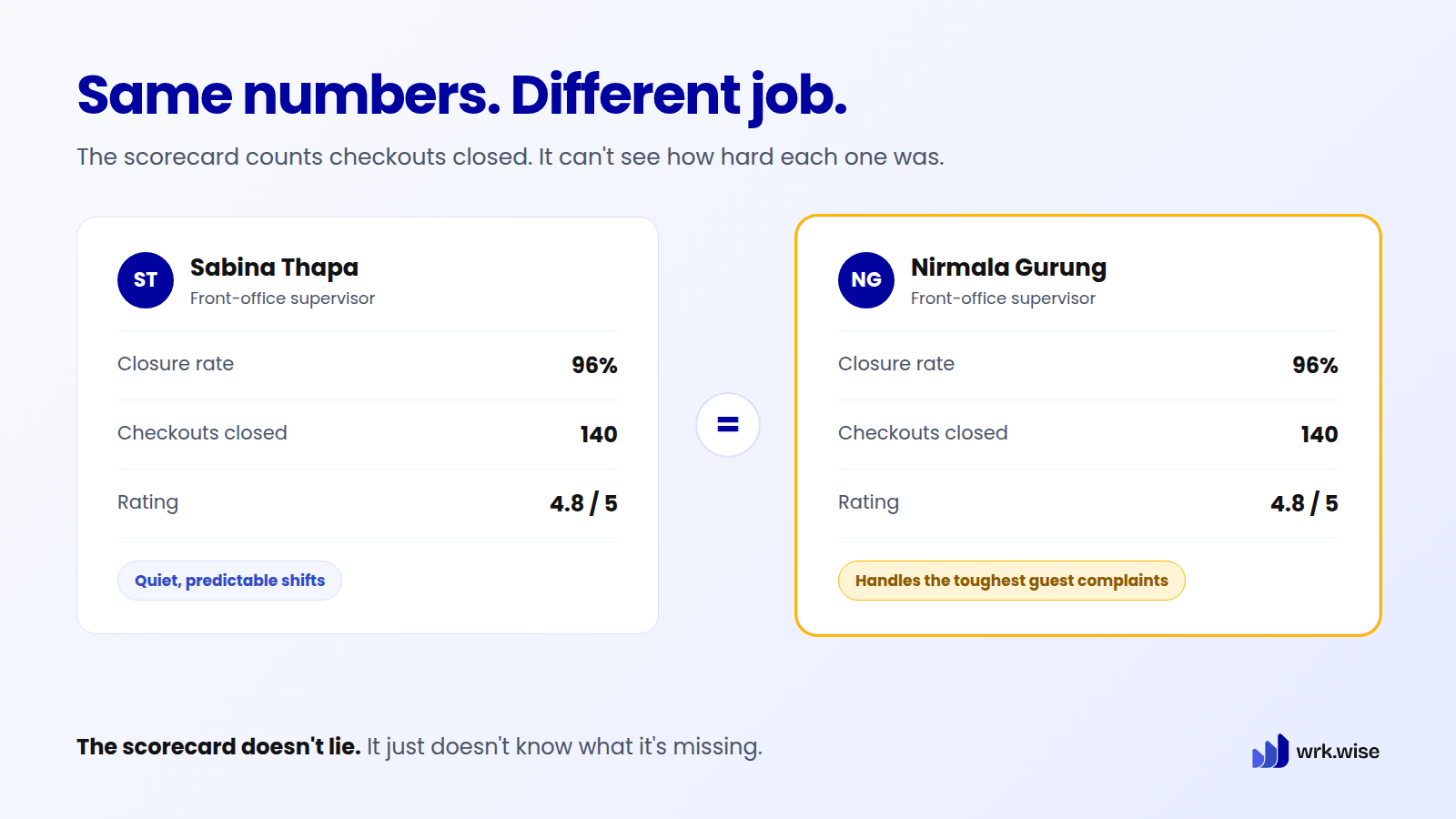
Picture a hospitality group in Pokhara. Two front-office supervisors, Sabina Thapa and Nirmala Gurung, look equally productive on paper. Same closure rate, same checkout numbers, same rating, appraisal after appraisal.
Sabina has quiet, predictable shifts. Nirmala handles the property’s toughest guest complaints and still resolves most of them well.
The scorecard doesn’t lie. It just doesn’t know what it’s missing. It counts checkouts closed, not how hard each one was to close.
A routine checkout and a difficult complaint both end the same way on paper: marked done. The system has no way to tell them apart, so it treats them as if they were.
Six months later, Nirmala resigns. The property loses the one person who was actually holding guest relations together.
The rules were applied the same way to both supervisors. That’s exactly what makes this harder to catch than an obviously broken process. A broken process is easy to blame. A fair one that still gets it wrong is much harder to catch, because nobody thinks to look for the problem in the first place.
Why Unfair Performance Appraisals Happen Even with Fair Rules
The Pokhara story isn’t rare. Most companies have a version of it running quietly in the background, every single review cycle. The form is fair. The scale is fair. The manager filling it out isn’t trying to get it wrong.
And yet, somehow, it still comes out wrong. A fair process depends on something far less reliable underneath it: a manager’s memory, judgment, and personal sense of what “good” looks like. Here’s where that breaks down.
It’s Bad Memory, Not Bias
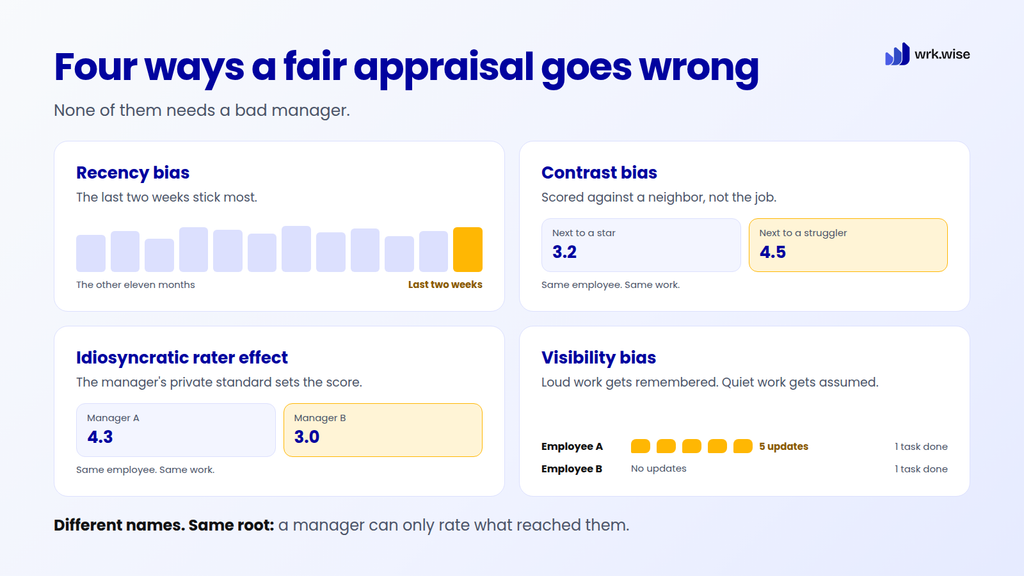
Most unfair performance appraisals have less to do with favoritism and more to do with timing. They’re about a manager remembering last week better than three months ago.
This is recency bias, one of the most common reasons a fair process still produces an unfair result. An employee with a rough final fortnight looks worse than the one who coasted through it, even if the first employee carried the team for the other eleven months. The appraisal isn’t measuring the whole period. It’s measuring whatever the manager happened to remember.
Nobody plans for this. No manager decides to ignore three-quarters of someone’s year. It just happens, because most appraisal processes were never built to work around how memory actually behaves.
Ranked Against Each Other, Not the Job
There’s a second, quieter way a fair process goes wrong. A manager rates one employee against another, instead of against the actual standard for the role.
This is contrast bias. Put a strong performer next to an average one, and the average one looks worse than they are. Put the same performer next to someone struggling, and they suddenly look like a star. The score changes, but the work underneath hasn’t moved at all. Only who was standing next to them at review time changed.
This is why two managers can apply the same appraisal form to two different teams and land on completely different standards, without either one breaking a single rule.
Same Employee, Different Manager, Different Score
The most researched appraisal problem isn’t about the employee at all. It’s about the manager doing the rating.
This is the idiosyncratic rater effect: give two different managers the same employee’s work, and the scores diverge more from each other than from the employee’s actual output. Studies on this consistently find that ratings say more about the rater’s personal standards than about the person being rated.
This is the hardest bias to train away, because the rater isn’t wrong exactly. They’re measuring against a private, unspoken bar nobody else can see. Keep this one in mind. We’ll come back to it later, because it’s also the one honest limit on what any system, including the one this piece eventually gets to, can promise to fix.
Visibility Skews Fair Performance Evaluation
Some employees update everyone constantly. Every finished task gets a message. Every small win gets a mention. Others just do the work, quietly, without narrating it.
A manager naturally notices the first employee more, simply because there’s more to notice. That’s not a judgment on either person’s actual output. It’s just how attention works.
But there’s a second, quieter version of this problem too, one that has nothing to do with how someone talks about their work. Both versions start the same way: something goes unnoticed, and the appraisal has no way to account for it.
Updates Get Remembered. Work Gets Assumed.
An update is a description of work, not the work itself. An employee who sends five messages about a task in progress isn’t necessarily further along than one who sends none and simply finishes it.
The first employee is easier to picture at review time, because there’s a trail of proof sitting in the inbox. The second employee’s proof is just the finished result, sitting quietly in a folder nobody reopened.
Over time, this becomes a quiet penalty. The reliable, low-noise employee gets treated as steady but unremarkable, while someone better at narrating their work rises above them, even with a similar or lighter load.
Nobody sets out to reward talking over doing. Appraisal after appraisal, the loud employee simply leaves more behind to be remembered by.
Fixing a Problem Isn’t the Same as Preventing One
Some work only becomes visible when something goes wrong. An employee who catches a shipment before it goes out damaged, or fixes a client issue before it escalates, produces something everyone can see and praise.
The employee who prevents that same problem from happening in the first place produces nothing to see at all. No crisis, no fix, no story to tell at review time. Just an ordinary day that stayed ordinary, because someone did the quieter work of making sure it would.
This is a different kind of invisibility than staying quiet about a finished task. It’s not about communication style. It’s about the fact that good process discipline rarely looks like anything.
Nothing breaks, so nobody notices what didn’t happen. The employee doing the harder, more valuable work of prevention often walks away with a lower score than the one who got to be seen solving a problem better discipline would have avoided entirely.
This Isn’t Just You
If any of this sounds familiar, it’s because it’s common, not because you’re imagining it.
If this sounds like your own appraisal season, forward it to whoever actually runs yours. They’re the ones who can do something about it, and the next part of this is written for them.
If You’re the One Running Appraisals
Everything above was written for the person sitting through a review. This part is for the person building one.
And it’s worth saying plainly, because the wrong reading of what follows is an easy one to fall into: none of this is about watching people more closely. It’s about the opposite. Nirmala, from the Pokhara story, didn’t need a manager paying closer attention. She needed a record that would have shown what she was actually carrying, before she was the one who had to quit to make the point. A better record isn’t surveillance. It’s what would have kept her.
What Actually Causes Appraisal Bias
Every example so far shares one root cause. Not a bad manager. A manager working from an incomplete picture.
One Task, Five People, One Name
A project finishes. A report reaches the client. One name is on the delivery.
But five people touched it first. One caught a data error before it went out. Another rebuilt a section overnight after a late scope change. A third made sure it reached the right approver on time instead of sitting in an inbox for two days.
None of that shows up anywhere. The appraisal only sees who hit send. Everyone else’s work disappears the moment the task is marked complete, not because it didn’t matter, but because nothing recorded that it happened.
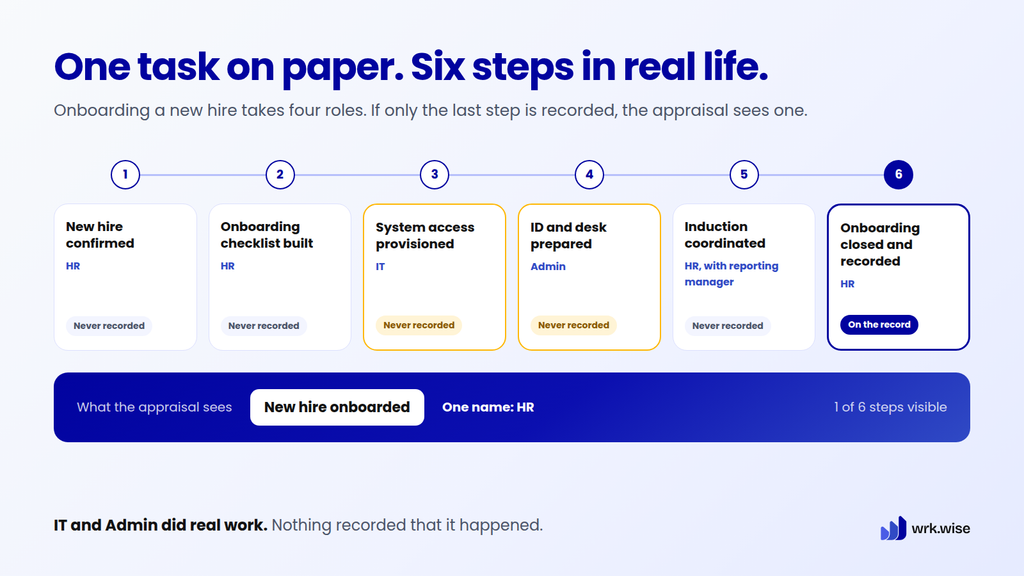
Onboarding a new hire is a smaller, more ordinary version of the same problem. It looks like one task with one name attached: “new hire onboarded.” In reality it’s a sequence. HR confirms the hire and starts the paperwork. HR builds the onboarding checklist. IT provisions system access. Admin prepares the ID badge and the desk. HR coordinates the induction with the reporting manager. HR closes the loop and confirms everything landed. Six steps, four different roles, one finished process. If only the last step gets recorded, IT and admin did real work that never shows up anywhere come appraisal time.
It’s What the Manager Can See
Recency bias, contrast bias, the rater effect, visibility, and invisible prevention work. Different names, same root: a manager can only rate what reached them.
Memory fades, comparisons distort, standards vary, quiet work goes unrecorded. Underneath all of it, the manager never had the full picture to begin with. Blame the manager, and you get a slightly more careful manager next cycle. The gap stays exactly where it was.
A better manager was never going to close that gap. What closes it is a system that captures what happened, before it reaches the manager at all.
Filtered Through Three Layers, Then Scored
A report moves up the chain. Each person softens a rough detail on the way up. Nobody’s trying to mislead anyone. They just don’t want to be the one who sounds like they dropped the ball.
By the time it reaches whoever fills out the appraisal, the version being scored isn’t the real one. A shipment delay became a “minor hold-up.” A client complaint became “resolved.”
Even a manager with perfect memory and zero bias is still scoring a filtered account. The distortion happened upstream, before it ever reached them.
Why More Metrics Don’t Fix Unfair Performance Appraisals
The usual advice here is to add more quantifiable indicators. Score things objectively, and the bias disappears.
The Pokhara supervisors already had that. Checkout speed is about as objective as a metric gets. It still produced an unfair result, because the number measured volume, not difficulty. More metrics don’t fix appraisal fairness on their own. They just make the same mistake more precisely.
A Metric Without Context
A score without context is a guess wearing a decimal point.
Forty tasks completed sounds better than fifteen. But Sabina’s forty routine checkouts and Nirmala’s fifteen difficult guest complaints aren’t the same kind of work, and a single number can’t tell them apart. The metric looks rigorous. It’s answering a question nobody actually asked: how much got done, instead of how hard it was to do.
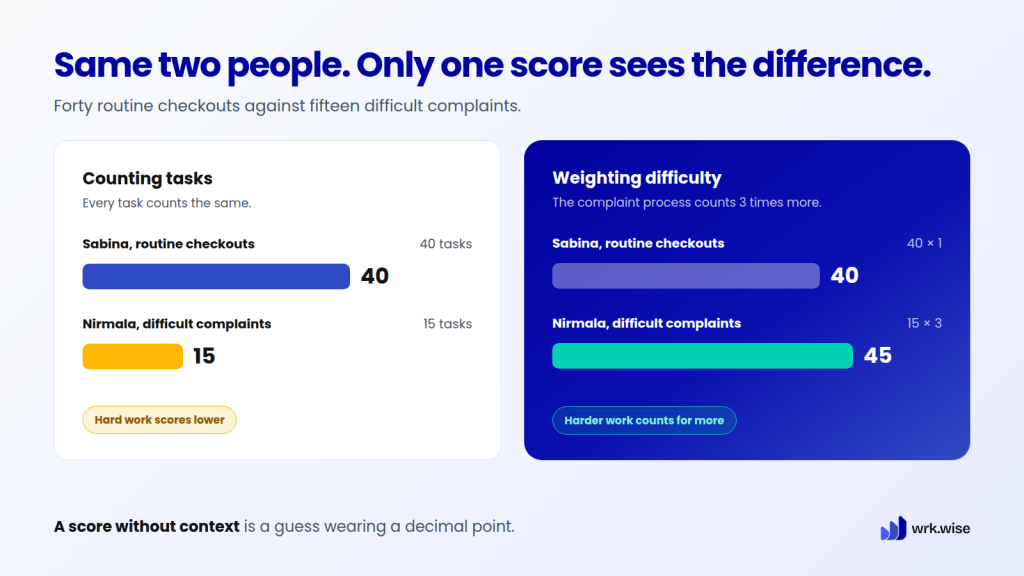
This is the trap. A precise number feels like proof. It isn’t proof of fairness, only proof of counting.
When a Metric Knows the Task
The fix isn’t fewer numbers or more numbers. It’s a number that knows what it’s attached to.
A completed task and a difficult, high-stakes task shouldn’t sit on the same scale. Once a metric carries the task’s context along with it, difficulty, ownership, what kind of work it actually was, the comparison stops being volume versus volume, and starts being value versus value.
That single shift changes what the appraisal is actually measuring. Not who did the most. Who did the most that mattered.
Building an Evidence-Based Performance Review Process
Everything so far points to the same conclusion. The problem was never a lack of rules or a lack of numbers. It was a lack of record: evidence that survives past the moment the work happened, instead of relying on what a manager remembers, compares, or happens to see.
Score Tied to Ownership, Not Outcomes
A finished task usually has one name on it. The work behind it usually has several.
An evidence-based review doesn’t just ask what got delivered. It asks who actually did what, at which step. The person who caught the error before it shipped and the person who hit send aren’t interchangeable, even though only one name shows up on the final result. Scoring the outcome alone erases everyone who isn’t standing at the finish line.
What Workload Visibility Changes
Two employees can look equally busy and be carrying completely different loads.
Without visibility into what each person is actually holding, a manager is left guessing who’s overworked and who isn’t. That guess usually favors whoever’s problems are loudest. With workload visible across a team, difficulty and volume stop being invisible variables, and start being something an appraisal can actually account for.
How wrk.wise Turns Records Into Evidence
This is the layer most appraisal processes are missing. Not more rules. A record.
The Record Behind Every Task
Inside wrk.wise, most tasks are generated automatically from a company’s SOPs. When one step finishes, the next one appears in the right person’s queue on its own. Nobody has to remember to log anything, because the system was already the place the work happened.
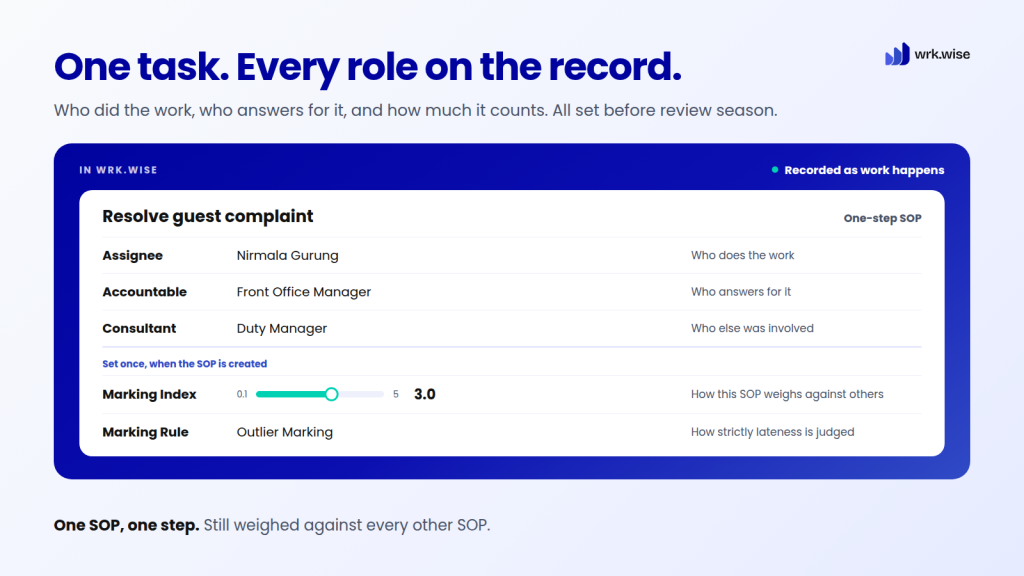
Every task carries two roles that most appraisal systems collapse into one: an Assignee, the person doing the work, and an Accountable, the person answering for whether it’s done right. They don’t have to be the same person. A task can also name Consultants, people who were involved without owning the outcome. That’s the direct answer to the “one name on the delivery” problem. The record can show who executed, who’s answerable, and who else touched it, instead of flattening all of that into a single signature line.
How Much a Task Counts
How much a task counts is decided in advance, not guessed at during review season. Inside one SOP, each step carries its own weight, so a harder step in the same process counts for more than a routine one. Across different SOPs, each process carries its own Marking Index, a multiplier set once when the SOP is created, so an entire process like resolving a guest complaint can count for more than an entire process like handling a routine checkout, even when each lives in its own separate SOP. A business expert, often a consultant or a senior employee who knows the process end to end, sets these numbers once, calmly, long before anyone is under pressure to remember how hard last quarter actually was.
Timing gets its own honest treatment too. Each step also carries a Marking Rule, which decides how strictly lateness gets scored for that kind of task. A routine SOP step can carry a strict rule, since its deadline was never really in doubt. A delegated task, where the timeline came from a conversation rather than a fixed process, can carry a more forgiving one. An outlier situation, the kind of complaint that doesn’t fit a standard checklist, can carry the most forgiving curve of all, since taking longer there often means the problem was genuinely harder, not that someone was slow.
That’s the direct answer for Nirmala: her complaint-handling SOP can carry a higher Marking Index than the routine checkout SOP, so the process itself counts for more before a single task is even scored. And running long on a hard complaint isn’t judged the same way as running late on a routine one, because the two were never set up with the same tolerance for delay.
What This Does and Doesn’t Fix
It’s worth being precise about what this does and doesn’t fix. Give the same employee’s work to two different managers, and their scores will still diverge somewhat. That’s the idiosyncratic rater effect, and it lives in the rater’s private standard, not in a missing record. No system removes that completely, and wrk.wise doesn’t claim to. What it does is smaller and more honest: it doesn’t replace a manager’s judgment. It gives that judgment something real to work from, instead of memory, comparison, and whoever happened to complain loudest.
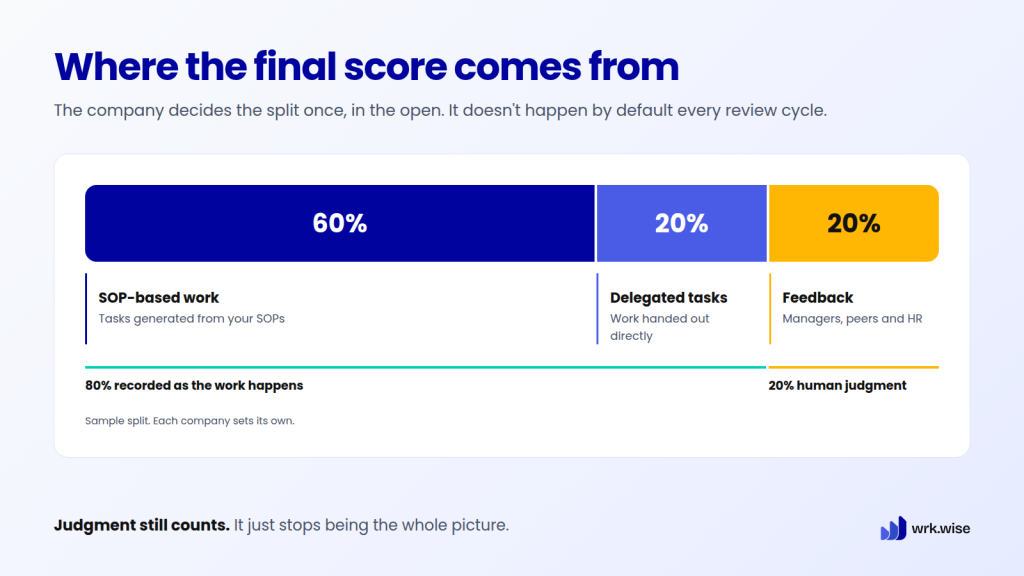
That’s also where human judgment gets a defined, bounded role instead of an unlimited one. A company sets a Marking Weightage once, deciding how much of someone’s final score comes from recorded SOP and delegated task work versus feedback from managers, peers, and HR. The feedback itself still carries all the bias this piece opened with, a rater’s private standard doesn’t disappear because it’s one input among several. But it stops being the whole picture by default. A company can set feedback at ten percent of the final score or forty. Either way, that’s a decision made in the open, once, instead of something that quietly happens by default every review cycle.
One more thing worth saying plainly: this only works as well as the SOP it’s built on. A process written as one broad step with one name attached still collapses to whoever hit send. The system earns its keep when the SOP itself is designed to track who owned which step, not just who finished the task. That’s a design choice a company makes, not something that happens automatically the day it signs up.
When appraisal season comes, the manager isn’t working from what they remember. They’re working from what actually happened.
That’s the difference between an appraisal built on impressions and one built on evidence.
If your appraisal process is still running on memory and good intentions, it’s worth seeing what one built on evidence looks like. Book a demo to see how wrk.wise works with your own SOPs.
FAQs
Why do fair-looking appraisals still feel unfair?
Fair-looking appraisals still feel unfair because the rules are applied evenly, but the information behind them isn’t. Managers work from memory, comparisons, and filtered updates, not a full record of what actually happened. The process is fair. The picture it’s judging from often isn’t.
What is recency bias in performance reviews?
Recency bias in performance reviews happens when a manager weighs recent events more heavily than the full review period. An employee’s last few weeks end up shaping their score more than the previous eleven months, even when the earlier work mattered just as much.
Can software fix the idiosyncratic rater effect?
Not fully, and it’s worth being honest about that. The idiosyncratic rater effect comes from a manager’s private, unspoken standard, not from missing information. A better record can’t rewrite someone’s internal bar. What it can do is make sure the manager is scoring the same, complete picture every time, instead of whatever they happened to remember or notice.
How can HR make performance appraisals more transparent?
HR can make performance appraisals more transparent by basing scores on recorded task ownership and outcomes, not manager memory or year-end summaries. Sharing how each score was calculated, and tying ratings to specific, dated work, gives employees a clear, checkable reason behind every rating.
Do quantifiable metrics guarantee a fair appraisal?
No, quantifiable metrics alone don’t guarantee a fair appraisal. A number without context, like tasks completed, still ignores difficulty and effort. Fair scoring requires metrics tied to what each task actually involved, not just how many were finished.
How does wrk.wise support fair performance evaluation?
wrk.wise supports fair performance evaluation by recording task ownership, accountability, and difficulty as work happens, not after the fact. Each SOP carries its own Marking Index, weighing it against other SOPs, and each step within it carries its own weight and Marking Rule, all set in advance by whoever designed the process. Appraisals end up based on evidence instead of a manager’s memory or impression. It doesn’t replace a manager’s judgment. It gives that judgment something real to work from.