




 Aug 03,2026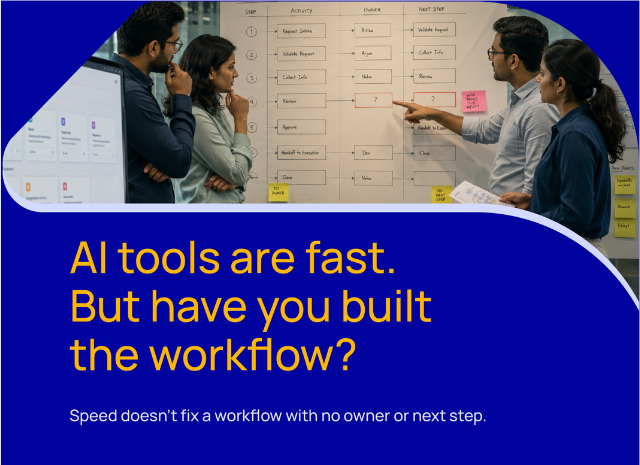
AI tools are entering every workplace. Tasks are getting faster. But many businesses still face the same old problem: work is scattered, ownership is unclear, and no one is quite sure what happens next.
When the French painter Paul Delaroche first saw a photograph, around 1839, he reportedly declared, “From today, painting is dead.” The new technology seemed destined to replace the old craft entirely.
Painting survived. Photography did not eliminate art. It changed what art was for.
The conversation around AI feels similar today. Every week brings a new prediction about jobs disappearing, roles collapsing, industries transforming overnight.
Some of that may prove true. But new technologies rarely remove the need for work itself. They change how the work gets done.
And underneath all of that change, one thing has not moved: businesses still run on processes.
How AI Is Changing Jobs and Tasks
AI is changing jobs by changing the tasks inside them. It automates routine work, assists with decisions, and raises the value of human judgment.
The shift is not simple, and it is not one-directional. AI is not only replacing people, and it is not only helping them. It is splitting work into three piles: tasks that can be automated, tasks that can be assisted, and tasks that still need a person.
Clean Tasks, Messy Tasks
Economist Luis Garicano, who co-authored the book Messy Jobs, describes most white-collar roles as a mix of two kinds of work.
Clean tasks are predictable and rule-based. They are easy to hand off to a machine. Messy tasks involve judgment, relationships, and situations with no clean answer. They are hard for any AI to touch.
Picture a factory manager. Her Tuesday starts clean.
She opens her laptop, and an AI tool has already drafted the week’s production summary. It has pulled yesterday’s output numbers and flagged two invoices that don’t match the purchase order. She checks them, approves what looks right. The morning is done in twenty minutes instead of two hours.
By 2 p.m., the day turns messy. A key supplier calls to say a shipment will be late, and it will delay two client deliveries.
The factory manager has to decide which client to tell first. She has to weigh pulling stock from another line against straining a long-standing vendor relationship, all while still trying to hit the deadline. No tool drafts that conversation for her. No dashboard tells her which client will forgive the delay and which one won’t.
Same job. Same person. One half of her day got faster. The other half still needed her.
Garicano’s wider research on AI and job boundaries makes the same point at scale. A job is not one task. It is a bundle of tasks, and AI’s real impact depends on how easily that bundle can be pulled apart.
Jobs Are Being Redefined, Not Deleted
ADP Research calls this “the great job unbundling.” As AI absorbs more of the clean, repeatable parts of work, jobs will be defined less by title and more by what a person actually spends their day doing.
That shift is already visible in the numbers. PwC’s 2026 AI Jobs Barometer found that companies best able to use AI are growing headcount faster than less AI-exposed companies, 52 percent versus 36 percent.
The same report found that AI-exposed entry-level roles are now seven times more likely to demand traditionally senior skills, like judgment and leadership.
For a business owner, this cuts both ways. AI can help a team move faster. It also quietly rewrites job descriptions, reporting lines, training needs, and what “doing the job well” even means.
AI is changing jobs. It is not removing the need for organized workflows, clear ownership, or structured execution. If anything, it is raising the price of not having them.
What Still Does Not Change in Business Operations
If AI is changing what people do, the next question is simpler: what is not changing? The core work of the business.
Tools evolve. Job titles shift. Teams pick up new software every year. But every business still depends on the same handful of functions to survive: sales and marketing to drive growth, operations to deliver the product or service, finance to protect the company’s health, HR to build and support the team, and customer support to protect trust.
AI does not delete these functions. It changes how the work inside each one gets done. Marketing may use AI for content, finance for reporting, HR for screening, support for a chatbot.
But someone still has to decide what matters, who owns the task, what happens next, and how the outcome gets measured. AI is a productivity multiplier, not a replacement for responsibility. That is why AI and business operations need more than tools. They need a process that keeps the work connected.
Why Every Business Function Runs on a Process
A business function only works when there is a process behind it. Without one, a team can be busy all day and still not move the business forward.
Take hiring. On paper, hiring looks simple: a role opens, someone applies, someone gets picked. In practice, it is one of the easiest processes in a growing company to quietly break.
A manager opens a role and posts it, but forgets to loop in HR on the exact requirements. Candidates apply, and three of them look strong. One manager reviews them, likes two, but is buried in his own work for a week before he replies.
By the time feedback comes back, the strongest candidate has already accepted a job somewhere else. No single person did anything wrong. The process simply had no owner at the handoff point, so the delay belonged to no one and cost the business its best applicant.
That same pattern, an unowned handoff, a delay nobody is accountable for, shows up across every core function:
- Sales: A lead is qualified and ready to close, but sits untouched over a weekend because no one owns the follow-up after the first call.
- Customer onboarding: A new client signs, but the handoff from sales to delivery is never formally made, so the client’s first thirty days drift with no one actively guiding them.
- Project delivery: A task is finished, but the next person in the chain does not know it is ready, so the project stalls at a step that technically has no blocker at all.
Different function, same failure. Work exists. Ownership does not.
Why AI Without Clear Processes Creates Confusion
AI can make a task faster. It cannot, on its own, organize how work moves across a business.
Speed helps. Without a clear process behind it, teams still struggle with the same old questions: who owns this, who approves it, and what happens once it is done.
Kotak Mahindra Bank is a useful, recent example of this exact gap. By 2024, the Indian bank was processing most of its new personal loans and credit card applications through digital channels. Its digital front end had scaled well.
But the systems and operating controls behind that growth had not scaled at the same pace. After repeated outages and roughly two years of unresolved IT concerns, the Reserve Bank of India stepped in and stopped the bank from onboarding new customers digitally or issuing new credit cards, citing weaknesses in change management, access control, vendor management, and business continuity.
The problem was never a shortage of digital tools. Growth had simply moved faster than the process and controls needed to support it safely. AI creates the same risk for any business. Placed on top of an unclear workflow, a powerful tool does not fix the confusion. It just automates it, and it does so faster than a human ever could.
Why Structured Execution Will Win
The winners of the AI era will not simply be the businesses running the most AI tools. They will be the businesses that know how to fit those tools inside a clear operating structure.
Tata Steel offers the opposite lesson from Kotak Mahindra’s, and it is worth sitting with. Before scaling any digital tool, the company built a formal transformation process.
Leaders aligned on specific business problems first. Initiatives were tested in small pockets before being rolled out. Only what actually worked got scaled further. Technology came second, after the company understood exactly which process it was trying to improve.
When Tata Steel built AASHIYANA, its digital platform for home-building customers, it started by mapping the customer’s actual journey, not by picking a piece of software. The platform supported a sales process that had already been redesigned around the customer. It was not bolted onto an old one.
That is the difference between a tool that speeds up chaos and a tool that speeds up clarity. A business with ten AI tools and no clear process may still struggle to show for it.
A business with a strong process can put AI to work immediately, because the structure to receive that speed already exists. Documented knowledge, clear ownership, and visible deadlines are not old-fashioned overhead in an AI-driven business. They are what makes the AI actually pay off.
From Process Documentation to Process Execution
Here is the uncomfortable part. Most businesses are not failing because they lack a plan. They have consultants, reports, workshops, SOP documents, and good intentions. The plan usually exists somewhere in a folder.
The gap opens the moment daily work begins. A task gets missed because no one was clearly its owner. A deadline slips because the person who needed to approve it did not know it was waiting.
The process that looked airtight in a slide deck turns out to depend, in practice, on someone’s memory and someone else’s follow-up call. It is the same clean-task, messy-task problem, just wearing a different name: the clean part, writing the SOP, gets done. The messy part, making people actually follow it every day, does not.
Closing the Implementation Gap
This is the exact implementation gap wrk.wise is built to close. It takes the SOPs and process maps a business already has and turns them into trackable workflows with a named owner, a deadline, and a visible next step, the same task ownership and workflow accountability the argument has been building toward, instead of leaving them as documents nobody opens after the first week.
Where a workflow stalls the way that factory line or that unfilled hiring role did, wrk.wise surfaces the delay before it becomes a missed deadline or a lost candidate, instead of after.
And where AI tools are already drafting the clean, repeatable parts of the day, wrk.wise gives that output somewhere to go: an owner, an approval step, a record of what happened and when. The same structure that let Tata Steel’s technology support a process instead of sitting on top of a broken one.
None of this replaces the judgment your team brings to the messy half of their work. It protects it, by making sure the clean half does not quietly eat the rest of the day through chasing, reminding, and re-explaining.
The Constant in an AI-Driven World
Delaroche was wrong about painting. He was not wrong that a new technology changes the ground under a craft. It just rarely removes the need for the craft itself.
AI will keep reshaping jobs, teams, and the way businesses operate. Roles will keep evolving. New skills will keep emerging. But underneath every shift, the fundamentals of running a business have not moved.
A business still needs a clear process to produce a repeatable outcome. It still needs clear ownership to move work forward. It still needs accountability to turn a plan into a result.
The businesses that come out ahead will not simply be the ones that adopted the newest tool first. They will be the ones that built a structure strong enough to hold it.
AI tools can change how fast work gets done. Organized workflows still decide whether that work actually moves.
AI tools are fast. But have you built the track?
Speed means little when work has no clear owner, deadline, or next step. See how wrk.wise turns your SOPs into workflows your team actually uses.
[See wrk.wise in Action] [Book a Demo]
FAQs
1. Will AI replace jobs completely?
AI is likely to replace some tasks, especially routine ones. Most jobs also involve judgment, context, and decision-making, and those parts still need a person.
2. How is AI changing jobs?
It is automating the routine parts of a role and raising the value of the parts that require judgment, communication, and ownership.
3. Why do processes still matter in the AI era?
Because a fast task isnot the same as a finished process. Even a task AI completes in seconds still needs an owner, an approval step, and a next action for the work to actually move.
4. Can AI fix a broken business process?
Not on its own. If ownership and approvals were never clearly defined, AI will make individual tasks faster while the overall process stays just as confusing.
5. What does structured execution mean?
It means turning work into workflows with a named owner, a deadline, and visible progress, so a team always knows what is next and who is responsible for it.
6. How does wrk.wise help?
It converts SOPs and process documents that already exist into trackable workflows, so implementation does not depend on memory or follow-up calls.
7. How can a business adapt to AI without adding more confusion?
Start by making the existing process clear before adding a new tool. A tool on top of a clear process speeds up the work. A tool on top of an unclear one just speeds up the confusion.
